Friday, July 17, 2009

The Soesters


Photos and story by Clay Lomneth


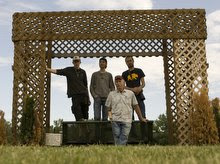
July 16th, 2009, Crawford, Neb: During this trip, I've met quite a few people that, if they were not doing what they are doing now, would have made good photographers. (Thank the photo god they were doing what they were doing, because we would have missed out on some great images). To me, Debbie Soester was one of them.


Kyle and I met Debbie after we went into a horse supply store in Crawford, acting on a hunch that someone that supplies horse owners might know local ranchers. It's hunches like these that make us good photographers. (It's that sense of sarcastic humor that grinds on Bruce's nerves, but that's another story.)


The owner of the store introduced us to Debbie as she walked by his store running errands. Hardly batting an eye, Debbie invited us to come to her house. It's chances like these that make us lucky photographers. 


Debbie and Alan Soester have lived on their ranch since the '70s, and have four hard-working (and brave) helpers, also known as their children: Aubrey, Chance, Haley and Austin, ranging from ages 19 to 13. In addition to farming wheat, the Soester's raise cattle when wheat season is over to supplement their income. We arrived good timing, too - the Soesters were some of the first in Crawford to farm their wheat. 


The first chore assigned to Aubrey and Haley when they got back from town was to administer first aid to a yearling bull who just got bit by a snake. Kyle and I tentatively followed Aubrey into the bull's pen. She gave us a look that we get a lot: half amused, but she knew we were in way over our heads. 


"Just stay close to the fence," she said, "so if he gets wound up, you can jump the fence."


Aubrey and Haley rounded up the bull and got him into the chute and Kyle and I set to work. Trying to get different angles, I stepped right in front of the bull for a spell. "You might not want to stand there," Debbie said, laughing. 


After Aubrey and Haley stuck an angry bull in the hind leg with a giant needle, I had the chance to talk to Debbie a little bit. She told me about her family's recent trip to Alaska, and showed me a photograph hanging up on her wall. I've seen a few photographs of whales flipping their tails in the past, but there had always been something missing before. They're usually shot mid-day in harsh light, or they look like they were shot with a 600mm lens and then cropped way down. Debbie's image is hands-down my favorite. It had none of these problems. Shot on an overcast day, it was perfectly exposed. She didn't make the mistake that an amateur might make by zooming in, giving the viewer no idea where the whale was seen. Debbie had the photographic smarts to give the viewer some action in the foreground (the whale) and show enough of the environment so that anyone who's been there could easily recognize it. 


Suddenly it made sense why the rest of the Soesters were so camera un-aware. They ignored us and went about their daily business as if we weren't there, because they were so used to Debbie doing exactly that. 


Maybe none of this had anything to do with luck. Maybe I am just not used to people taking you in, letting you become a part of their lives, feeding you lunch, trusting you (meaning Kyle) to drive their farm equipment. Maybe there are people who would do that in Omaha or in Lincoln, but it might take a bit to find them.


So thank you Alan, Debbie, Aubrey, Haley, Chance and Austin. And Debbie: keep shooting.


Rolling-hills roundup

One of the cattle ropers at the Fort Robinson rodeo on July 16th, 2009.


Photos and story by Kyle Bruggeman


July 16th, 2009, Fort Robinson, Neb: If you want to see the best topography of Western-Nebraska, don't take Interstate 80. Instead get on Highway 20 and head toward Crawford, Nebraska. You'll find plenty of rolling bluffs intertwined with small town life. Ranching and farming go hand in hand, and in between you'll find community events like fur trading, fairs, and of course rodeos.


Small scale rodeos like the ones held in Fort Robinson are a great way to get a taste of cowboy life without all the corporate logos seen in rodeo arenas. You can stand right on the fence where bucking broncos come jumping out and talk with the cowboys as they wait their turn to rope a calf.


These hard-working men and women come from different towns in different counties yet they'll all tell you they love living where they do because the people there care for each other and look out for one another.


Doug Bowman stands behind the horse gates of the Fort Robinson rodeo on July 16th, 2009. Bowman brought a horse of his for other cowboys to ride, "She's too wild to break, but she's great for bucking" said Bowman.

Vanishing breed

Raul Gomez, 67, has worked in fields all across the United States and has been coming to the Alliance area to work for more than 50 years. This year might be the last. A new chemical, eliminating weeds, has put most of the migrant farm workers out of work.

Story and photos by Bruce Thorson


July 15, 2009, Alliance, Neb: While in Bridgeport, I noticed a building with a sign in it signifying it was a migrant health clinic. I made a few phone calls and discovered the medical staff would be there Tuesday afternoon.

I arrived later that afternoon. The clinic was empty, except for the staff.

"Just a few years ago this waiting room would be filled with parents and families waiting for medical assistance," Kimberly Kurtz said. Working for Community Action Partnership, Kurtz and others, help migrant farm workers, their kids and families, provide health care and schooling.

But the assistance programs and the migrant farm workers are headed for possible extinction.

A new chemical sprayed on the crops migrants used to hoe weeds and thin, has virtually eliminated the need for their labor.

Migrant farm workers, and their families, would seasonally arrive in April or May in the Nebraska Panhandle. There they would find fieldwork until the end of potato harvest in late September or early October.


After a breakfast break, where Raul and his wife Dominga ate jalapenos and tacos, the pair assists each other getting up and back to the fields.

"All these fields used to be filled with migrants hoeing weeds. You would see truckloads of workers going by every hour, " Raul Gomez, 67, said as he wiped away the sweat from his face.

Gomez has been coming to this area for over 50 years and has worked in fields from the east coast to the west, from the south to the north.

This year will probably be his last. There are no jobs. He managed to find work in a 97-acre field for himself and his wife, Dominga, 65, his son, Rod, 42, and Rod's son, Rigo, 17. They are paid $7 dollars an acre for their work. Raul used about half of what he made just for the gasoline it took to get him and his family to work.

Workers are packing up and heading back to Texas. Gomez lives in Mission, Texas. Some workers have managed to find some odd jobs at the farms where they have worked for past 20 to 30 years.

Technology and chemicals have just about ended the life of the migrants. There will be work for them at potato harvest time. But it won't be worth it for the migrants to show up for about 30 days worth of work.


Peter Ozuna, 67, uses his hoe, that once was used to weed and thin crops, to pull down old insulation in a shop area. Peter found his farm employer, where he has done fieldwork for more than 20 years, was able to give him odd jobs to do at the farm.

Children of migrant workers arrive for school at about 6:15 in the morning. They walk slowly off the bus clutching blankets, yawning and, for some, a little crying, as they make their way to the place where they stay and learn until 4 p.m.

Ubaldo Gonzalez, 62, has been coming to the Alliance area for farm work for over 30 years. Here he is packing his truck and is being helped by his grandson, Ray Valdez, 10. Ubaldo and his wife, Mirba, 60, left at 4 the next morning, heading back to McAllen, Texas, which is about a 24-hour drive if one drives straight through. He'll return later for the potato harvest in September.

Thursday, July 16, 2009

Alliance: Carhenge


Story and photo by Bruce Thorson

July 14, 2009, Alliance, Neb: As I've journeyed across Nebraska I've mentioned to Nebraskans that I planned on shooting a photograph of Carhenge for this project. Most just rolled their eyes and commented that they didn't take it seriously as an attraction worth visiting.

Given the state of the auto industry, I thought it appropriate.

I had photographed it about six days earlier, right after the full moon. I wasn't happy with the picture I made at that time.

I wanted to return but the weather wasn't cooperating. I wanted to photograph it at night, using a long exposure (this one was about 45 minutes) to get the stars to move across the sky.

Finally, the weather report called for a clear sky. This one of two photographs I made.

Wednesday, July 15, 2009

Alliance faces

Photos and story by Kyle Bruggeman


July 15, 2009, Alliance, Neb: Photojournalism is about telling a story through a visual medium. Often times that story is summed up in a single frame, a frame that reveals everything without having to accompany a few paragraphs of text.


This submission is intended to try and reveal, or perhaps mask, some of those truths without revealing the subjects stories with accompanying text. See what type of personalities and traits as well as stories you might think these photos portray. Then read further down to see their story.


photo one


photo two


photo three


photo one: O.G. Smith, 73, is a retired military man. He has served in the Pacific and the Atlantic oceans. "I've killed many men in my life" says Smith, but by meeting him you wouldn't think he would hurt a fly. He's a genuinely friendly guy, and one of the few people that have approached me to talk instead of vice-versa. Photo taken in front of Smith's home in Alliance Nebraska on July 13th, 2009.


photo two: Micky Aruffo has been feeding people in need for twenty years. She and her husband Gene run a food pantry named Just Neighbors from inside their home. They work with anyone and everyone who is in need. "If a drug addict needs food, we feed em" says Aruffo "Everybody has to eat." Photo taken in Aruffo's living room in Alliance Nebraska on July 12th, 2009.


photo three: Macala Hood, 5, is just starting out in life. She lives on a ranch outside of Alliance where her family raises cattle and quarter-horses. Someday she too will have a story to tell. Photo taken at a local family event in the Alliance park on July 14th, 2009.

Monday, July 13, 2009

I am a lineman for the college

Story and photos by Bruce Thorson

July 13, 2009, Alliance, Neb: Darrell Birkhimer is a powerline instructor at Western Nebraska Community College. He has twenty students. The students did a variety of pole climbing maneuvers, such as reaching out across and touching hands with the climber on the next pole, climbing up and going over a cross-member and climbing to the top and then doing a 360 degree rotation around the pole.

I asked Darrell about jobs for these students when they are finished with the one-year training program. He said, "With the economy right now it has slowed the hiring process. There are a lot of workers who would have retired but because of the economy they are staying on right now. When things pick up, they will retire and there will be a lot of job openings."

To finish off the day's climbing exercises, Darrell has all the students pick a row of poles on one side or the other of the training area. With a coin toss, one row represents heads and the other tails. If the students guessed correctly, heads or tails, they are done climbing for the day. The losers go up one more time and then another flip of the coin. Losers continue to go up again until they win.

Very quickly everyone was finished except for one lone powerline student. He guessed wrong five times in a row.

I told him not to go to Las Vegas.


Sunday, July 12, 2009

A night at the drive-in

A thunder and lightning storm moved in on the drive-in moviegoers. Rain fell periodically through the two shows but not often enough to force people to leave.

Story and photos by Bruce Thorson


July 11, 2009, Alliance, Neb: I saw the sign by the highway out of the corner of my eye: Drive-in Movie. I could not remember the last time I was at one, or even remember the last time I past one.

I had to check it out.

I drove in through the exit. The entrance gate was locked and the exit gate was open. It made sense to me.

Inside the concession stand, in a room off to the side where the movie projectors resided, there was Gerald Bullard, the owner, spooling up the next movie: A Night at the Museum.

I explained the project. And there it was again, that Nebraska friendliness and hospitality.

Gerald explained that the drive-in was built from the ground up in 1991, and he claims it is one of two drive-ins in Nebraska.

About the economy and his drive-in he said, "We are open two nights a week, Saturday and Sunday. Business is good and we could be open a third night if we wanted to do that."

Gerald Bullard, the owner, says the drive-in, which operates two nights a week, could be open for a third night despite the economy.

Gerald Bullard gets the movies ready for the next night's showing while his dog, Ruby, roams the concession stand.

Full throttle: Motocycles, dragsters and model airplanes

Rob Black pulls up the plane's nose and puts it into a hover position, making it perform almost like a helicopter.

Story and photo by Bruce Thorson

July 10, 2009, Alliance, Neb: Rob Black is crazy about planes, radio controlled model airplanes that is. Rob, 48, has been flying for about eleven years.

Before his aircraft habit, he rode drag racing motorcycles. Then, he moved on to racing dragsters. He said he needed a change, a change that would bring about the opportunity to stay closer to home with his hobby and one that isn't so expensive.

He helps maintain the airpark for model aircraft located near the Alliance airport.

I spotted him flying his Extra 260, a stunt airplane. It's about 35 percent of the full-size version and his model has a 104-inch wingspan. I had wanted to fly a radio-controlled airplane since I was a kid.

I enjoyed watching him fly his plane. He could get it to perform all types of maneuvers--fly upside down, on its side, loops, barrel rolls and many more. "It takes an enormous amount of concentration," he said.

You see, when the pilot is standing on the ground--the plane going in many different directions from the pilot--left isn't always left, right isn't always right and so forth.

Rob has worked for Burlington Northern Santa Fe railroad for about 30 years. Right now he's one of the lucky ones as the economy has forced BNSF to layoff over a hundred employees here.

"The economy hasn't really affected me, not directly," he said. "God has been good. He's blessed me with my health, my job, money, His love and mercy," Rob said.

Tony

Tony uses oxygen to assist his breathing. He's been a smoker for over 50 years and continues to smoke. "I've already damaged my lungs. What's the use in quitting now?," he said.

Story and photos by Bruce Thorson


July 7, 2009, Bridgeport, Neb: Meet Tony. His last name is Grubham, but he goes by Tony and he's 70 years old. I had a couple of enjoyable conversations with him.

"Only in America can a guy sit on his ass, in a bathrobe all day and people come in and give him money. I'm probably the only guy in America that does that. It's the greatest country because you're not limited with what you can do," he bellowed out as he leaned back in his office chair.

When I first pulled up in front of his bait and tackle shop, located next to a small chain of lakes, I could barely see the boats, motors and canoes among the weeds. When I pulled open the rickety screen door to step inside, there was barely of pathway visible. His store is filled, and filled and filled with stuff--boxes of worm bedding, lures and fishing reels hanging from the ceiling, fox pelts hanging from the ceiling, outboard motors and boxes and boxes.

While I was visiting Tony, a couple of his loyal customers dropped in. He sold them all a couple dozen worms. But before he did, they would talk, talk about family and health and kids. One man walked in and asked Tony if he had a drop light he could borrow to hook up outside his camper so he could see. "Yeah, we came here to de-stress a little bit," he said. "My mom has cancer and it's been kind of hard."

Some of his customers have known Tony since they were kids. They would remember the popsicles and cookies he would give them.

Tony loves fishing and loves that people and kids love fishing. So much so, that if a kid walks into his store and can't afford to buy the worms, Tony will give them away.

He'll also let them, or anyone for that matter, look at his two rattlesnakes he has sitting in an aquarium on the floor. "I gave them snakes a couple of mice this morning," he growled out. "I don't see the mice in there anymore so I guess they're fed."

About the economy he said, "I don't tell Washington (D.C) how to run their business and they don't tell me how to run my business."

About President Obama he said, "I think he might be good from what I hear. He's trying his darndest."

Tony's bait and tackle shop reminded me a little of a similar shop I used to visit when I was young fisherman. There were boxes and boxes of stuff everywhere, and it all was coated with a thick layer of dust.

This time I was reminded of that bait shop, plus I was able to visit with a man named Tony. I hope we meet again.


This is Tony's Starvation Acres bait and tackle store, and just about anything else you need for fishing.

Inside his store, it is difficult to find a path leading through all the stuff he has there, but if you need just about anything, Tony most likely will have it.

Saturday, July 11, 2009

Foreclosure

Darrell Kraupie, owner of Kraupie's Real Estate and Auctioneers, talks on his cell phone and wipes away the sweat on his brow as he goes through the inspection of several buildings that are in foreclosure in Sidney, Neb.

Story and photos by Bruce Thorson

July 9, 2009, Bridgeport, Neb: I walked into the office of Kraupie's Real Estate and Auctioneers and introduced myself to the secretary. I gave her the pitch version of the project I'm working on. I could tell by the look on her face she was a little puzzled. That "look" is not uncommon, as I've been getting it ever since we started this journey to document life in Nebraska during the recession. Almost every time I meet people, give them the project description, they just look at me and say, "You want to photograph what?"

The secretary motioned for Alecia Kraupie to join in our conversation. She and her husband, Darrell, own the realty business. It's been around for over thirty years.

I asked Alecia if she had any house showings or any work regarding home sales that wasn't going to take place in the office.

She said, "Well, I do have to run over to a house and put up a sign." I asked if I could go along and take pictures of that. "You want to photograph me putting up a sign," she said somewhat quizzically. And I said yup, I do, and I did.

Before we could get out the door, before I could even get off of the reception-area couch, Darrell strolled out of his office and said, "I have to go to Sidney and look at a building. You wanna go along and photograph that?" he said.

I asked what the situation was in regards to the building and why it was for sale. He said, "It's a bank repo."

I said that's perfect for part of what this project is about.

All throughout this project I still get caught off guard at how friendly and nice people can be, people you meet and 20 seconds later they're saying something like, "I'm going to Sidney, you want to come along?"

I spent most of the day with Darrell and I had a great time watching him "look" at a building.

Afterwards, we wound our way back to Bridgeport the long way. "I gotta look at some ground," he said. That ground was three parcels of farmland he wants to sell. It is interesting how a wheat field can look different from one corner of its 160 acres to the other corner.

I learned, too, how you could look at the field and tell if it's getting ready for harvest. If you still see some ever-so-slightly green tints in it, it's not ready; and whether or not the wheat is ready from a moisture content perspective by biting into a kernel. You go for the crunch.

As we wound our way back to Bridgeport, we traveled on top of and through the bluffs, over the gravel roads, we drove past herds of yaks, llamas, donkeys and longhorn cattle. Yaks, llamas and donkeys on this "tuff cowboy" landscape called Nebraska? Oh, we saw some cattle, too.

My eyes were opened to signage, a building repo and new sights, and my life was filled with a new friend, Darrell Kraupie. Thanks Darrell.

After finding the right farmland location he was looking for, Darrell heads back into his truck and off to another field.

Darrell uses his hat to shield the sun from his camera's lens and the truck's bed to get more height for the picture's perspective.

Mail rider

Story and photos by Bruce Thorson

July 8, 2009, Bayard, Neb: A rider gets the experience of what it was like being a Pony Express mail carrier. About 45 riders participating in 2,000 mile trail ride from Mexico to Canada, stopped at the Flying Bee Ranch for several days rest. The group is a little more than halfway on its journey. For the mail delivery demonstration, riders stationed themselves at each end of the quarter-mile route. They carried a mail pouch from one end to the other where the mail was handed off. The next rider carried it back again.

Max Cawiezel gives the trail riders the history and operation facts and details about the Pony Express. Cawiezel is a member of the Nebraska division of the Pony Express Association, a non-profit group. The Pony Express was in service from April 1860 to November 1861.

Tuesday, July 7, 2009

Trail City, U.S.A.


A slide across a slip n' slide is how Zeth Patterson, 8, cools off on a hot day in Bridgeport, Nebraska on July 6th, 2009.


Photos and story by Kyle Bruggeman


July 7th, 2009, Bridgeport, Neb: Located in the panhandle of Nebraska, Bridgeport is the county seat for Morrill County. Founded in 1900 the city contains much history as it has seen the Oregon, California, Morman, and Sidney-Black Hills Trails, as well as the Pony Express. Which gave the city its rightful name of "Trail City, U.S.A."


Today it contains a wonderful group of people who, like most small towns and cities in Nebraska, care very much for each other and their community.


Jack Burg has been the mayor for seven years and is proud of how his city has a thriving school system, a multitude of social events and people he considers "loyal."


The towns economy is mostly agricultural and is doing well for itself. Bridgeport Ethanol LLC is doing well for itself and through smart management is able to produce forty percent of its own power.


Through and through the city has survived much of American history, and it seems intent on keeping it that way.


George Post M.D., 89, sits in his home in Bridgeport, Nebraska with a commemorative Theodore Roosevelt .30-30 rifle. Post has contributed much to his community as a doctor and has donated land for the local baseball field.


Rick Parker, 56, works as a bus driver and organizer for Camp Rock, a summer bible school program that started in 1946.

Monday, July 6, 2009

Chimney Rock views


Photos by Bruce Thorson


additional photo by Kyle Bruggeman


The Jencks family vacation includes a stop at Chimney Rock historical marker. From left mother Lori, Stephanie, Tiffany, father Paul and Brad pose for a photo at the Chimney Rock museum

Sunday, July 5, 2009

Bridgeport: Rodeo up!


Marce Vasquez (left) and Jack Wagoner pause during the national anthem before the start of the rodeo. Both men are Morrill County deputy sheriffs. Vasquez is a retired rancher and Wagoner still does some ranching. About the economy and the measures to fix it Wagoner said, "We're getting more socialism and that scares me. We're losing our sovereignty."

All photos by Bruce Thorson

July 4, 2009, Bridgeport, Neb: It was rodeo time!!!

During the saddle bronc riding, the cowboyys line up to watch the other riders coming out of the gate and taking a few snapshots of their own. With these cameras that now have video capability, the riders use the video to view, critique and improve their ability to ride.

Steve Richards and Tess Smith run to break up the snuggling between Aly Rocha and her boyfriend Trevor Smith. All are from Scottsbluff. Tess is Trevor's mom.

Brady Cross (right) takes a moment to compose himself before his ride in the saddle bronc event. Brian Green (center) was wondering why Cross was being so nervous before his event.

Garet Groshans finished watching one rider in the saddle bronc event and looks to see who is next up.

Robert Liska uses oxygen to help him breathe. He's been a rancher and a farmer all his life, and he rode in the rodeo from 1956 to 1976. His events were bareback, saddle bronc and bull riding. His career in agriculture, breathing grain dust, dirt dust, fertilizer and pesticides have made it difficult for him to breathe.

Kensie Hill (left), Ashley Green, Chelsi Lemmon, Brythny Hagerman, Sara Aschenbrenner and Nicole Houston enjoyed the antics and the performance of the rodeo clown.

Riders tried to put a saddle on a horse during the wild horse racing event.


additional photos by Kyle Bruggeman


A moment of reflection for Jeremy Hanson, 20, as he waits to compete in bareback riding event.


Logan Allen, 22, prepares for his bareback riding competition by practicing his arm placement. Mental readiness is of upmost importance for these riders.


After the rodeo a dance was held in the accompanying building. Lonnie Mead, 21, (left) shows his moves with Terri Bossart, 19, while the band played a modern country music song.